
Hello and welcome to Documensch Research, your one-stop-shop for what’s new in Jewish research.
September was a month for counting, and not just in the High Holiday liturgy. We begin with a new record in what American Jewish institutions spend on security and two new polls of Jewish voters heading into the midterms. Also, the past year has seen a good deal of action in community studies, so we’ve created a map to track them all.
On the academic side, a Canadian survey shows how fast Jewish Canadians’ sense of safety has eroded, two very different readings of the campus climate, an exploration of why Jews ran Tin Pan Alley, and how two summer camps taught the Israel-Gaza war during the summer of 2024. We close with a few finds from the fringes of the field.
Check us on the Documensch Daily website or on Bluesky to get the latest. As always, reach out with feedback, suggestions of people we should interview, or ideas for documents we should consider archiving. We can be reached at bermanarchive@stanford.edu.
Without further ado,
-Ari
Ari Y Kelman, Director, Berman Archive at Stanford
Community Research
$ecurity: JFNA reports that American Jewish institutions now spend $1.015 billion a year on security. That’s 33% more than JFNA’s previous estimate of $765 million in 2024, or roughly $225,000 for every synagogue, JCC, school, and camp. The estimate combines JFNA’s institutional census with cost benchmarks and federal grant data.
Poll Position: Two polls of American Jewish voters and one poll about Jewish candidates landed this month:
➤ A Jewish Voters Resource Center survey of 800 Jewish voters, fielded by GBAO, finds 67% planning to vote Democratic in the midterms, 71% emotionally attached to Israel, and 65% disapproving of the Israeli government’s policy in the West Bank and Gaza.
➤ The Jewish Electorate Institute’s poll, also of 800 voters and fielded by the Mellman Group, finds 56% believe Netanyahu’s actions have increased antisemitism in the US. It also finds 52% support cutting or eliminating US aid to Israel: 63% of Democrats against 33% of Republicans and independents.
➤ Outside the Jewish electorate, a Politico/Public First poll of 2,002 US adults found observance cuts both ways: Democrats were less likely to back a Jewish candidate who regularly attends synagogue than one who doesn’t practice, while Republicans preferred the regular attendee.
All Over the Map: Regional Research from the Past Year
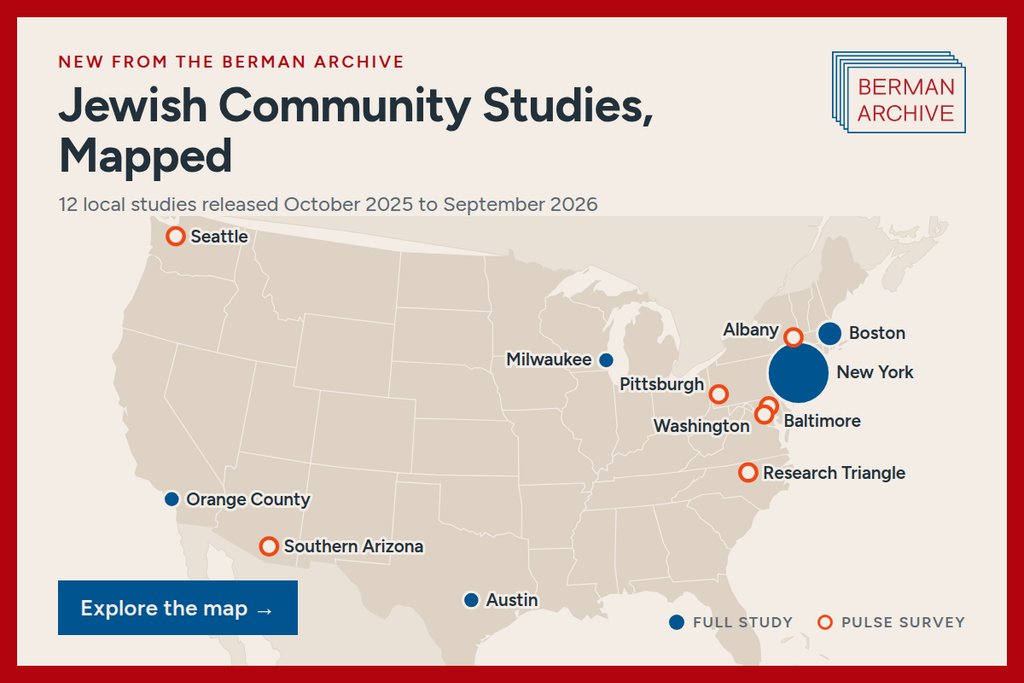
Federation-commissioned community studies have come out at a steady clip this year, and several now ask respondents directly whether they call themselves Zionists. Here is what we’ve tracked, and mapped, so far:
Boston: CJP’s 2025 Greater Boston study (Rosov Consulting, released in February) counts 333,100 people in Jewish households, up about 8% over the decade, but only about 228,500 of them are Jewish; 51% of households include someone who isn’t Jewish. Among adults under 30, more identify as anti-Zionist (38%) than as Zionist (32%).
Milwaukee: The Cohen Center’s Milwaukee study (June) finds 27,500 Jews with a median adult age of 61, against 49 nationally. The community splits almost evenly on the Zionist label, 43% to 42%, even as 69% feel attached to Israel.
Austin: At the other end of the age curve, the 2025 Study of Jewish ATX (August) counts 62,400 Jews with a median adult age of 44. 44% of adults moved there within the past decade.
Orange County: The Cohen Center’s Orange County study (July) finds a Jewish community as purple as its county. Half identify as Democrats, well below the national Jewish share, and attachment to Israel tracks politics.
Small Towns: A JFNA survey (June) finds Jews in smaller communities experience antisemitism at similar rates but get less support: 39% say local police take it seriously, against 47% in larger communities.
Northern California: Prizmah’s national figures show day school enrollment up 7.5% since 2021–22, but only 0.2% in the West. J.’s own decade of Bay Area data shows churn beneath that flat line, with rising tuition blunting the post-Oct. 7 bump.
Canada: Canadian Jewish Studies published Rachel Margolis on Jewish fertility, which held steady from 2001 to 2021 while other religious groups’ declined. The same journal carries Lilach Marom on how university equity policies sideline antisemitism. In August, the CASE survey found 95.7% of Jewish students on Canadian campuses had experienced or witnessed antisemitism, and Brym’s analysis of the 2025 federal election traced a Jewish shift toward the Conservatives driven largely by antisemitism.
Academic Research
Golden Age Over: In Canadian Jewish Studies, Robert Brym and Rhonda Lenton’s Canadian Jewish Barometer 2026 finds 88% of Canadian Jews feel less safe than they did five years ago, up from 63% in 2024, and 26% have seriously considered leaving the country. A majority of non-Jewish Canadians (54%) now call the Gaza war genocide. Left-leaning Canadians hold the warmest views of Jews alongside some of the coldest views of Israel.
Campus Climate: Two studies read the same campuses from opposite ends. A Cohen Center survey of 3,989 undergraduates at 303 US colleges finds 75% agree that Israel is committing genocide, while 20% are hostile to both the Israeli government and the Israeli people; the largest group of respondents, 34%, is warm toward civilians on both sides and says it knows little about the conflict. In the Journal of Contemporary Antisemitism, Gunther Jikeli and Daniel Miehling map nearly 10,000 antisemitic incidents at 571 universities against more than 1,000 anti-Israel campus groups. They find incidents cluster where those groups are active, and Instagram’s co-author feature tied SJP chapters into networks with off-campus groups.
Revising the Hits: Tin Pan Alley was the cluster of New York publishers who turned popular songwriting into an industry between the 1880s and the 1920s, and Jewish immigrants ran most of it. The usual explanation is that they were shut out of respectable professions and brought commercial instincts over from Europe, but Ari Katorza argues in Jewish Culture and History that this doesn’t hold up: Irish and Italian immigrants faced the same exclusion and arrived with richer musical traditions. His answer is that Jews were younger, more literate, and less bound by communal institutions, so they moved fastest into a business the establishment considered disreputable and became the middlemen who sold Black music to white middle-class America.
Notes on Camp: In Contemporary Jewry, Tal Vaizman recounts the summer of 2024 at two North American Jewish overnight camps: they responded to the Israel-Gaza war with opposite strategies, dubbed aboutism and virtuism. The Pennsylvania camp ran Israeli-led expert sessions on geography, institutions, and the conflict, while the Maryland camp facilitated dialogue aimed at moral development and camper voice. Neither held up on its own, since the first left little room for reflection and the second produced discussion without shared foundational knowledge. Vaizman argues camps should combine them by starting with factual framing and moving to facilitated reflection.
Documentions
Fur Facts: Wildlife ecologist Sam Zeveloff investigated how many animals are used to make a shtreimel, the fur hat worn by married Hasidic men, and found no compiled industry data on species, origin or sustainability. He found only a single fur-maker’s unsourced estimate of 10,000 hats sold worldwide per year. His essay in the Forward traces the garment’s history, noting scholar Levi Cooper’s finding that the shtreimel wasn’t an exclusively Hasidic marker until after World War II.
Hand Reading: VILNISH, a tool built by Sergii Gurbych at Vilnius University’s Center for the Study of East European Jewish History, turns handwritten Yiddish and Hebrew into searchable text, and families are using it to read letters that no one could read otherwise.
Stumbling Stones: A Hamburg brand consultant researching his office building found it had been Max Moses’s bedframe factory, seized in 1938 along with an inventory listing “21 pillowcases, 4 desk lamps, 30 pairs of socks and a metal sardine fork.” He laid a Stolperstein, one of the small brass plaques set into sidewalks across Europe to mark where victims of Nazi persecution lived or worked, and posted about it on LinkedIn, where Moses’s great-grandson found it. Moses had fled Germany in 1938 and rebuilt his life running a five-and-dime in Berkeley.