What does it mean to study American antisemitism as a historian? Not a journalist, not a theorist, but someone trained to read what the archives actually say? With her forthcoming book Sanctioned Bigotry: A Documentary History of Antisemitism in the United States (Yale University Press, May 2026), Britt Tevis, assistant professor of history at Syracuse University, offers a fresh and unsettling answer: antisemitism in the United States has always been, at its core, a political project and a sustained effort to deny Jews equal civil and political rights. We connected with Tevis this week to talk about the 178 documents she assembled for this book, what they reveal about the intellectual forces driving anti-Jewish bigotry in America, and why she thinks most public conversation on the subject is still getting it wrong.
Tell us a bit about your background, research interests, and your new book.
Britt Tevis: I am a historian by training. I earned my Ph.D. and J.D. from the University of Wisconsin-Madison, where I had the good fortune of learning Jewish history from Tony Michels and David Sorkin. My research examines the intersection of Jews and law, illuminating the many legal entanglements between Jews and the state. My new book, Sanctioned Bigotry: A Documentary History of Antisemitism in the United States, exemplifies my research interests by illuminating instances of anti-Jewish bigotry, violence, and discrimination that, to varying degrees and in different ways, involved the country’s legal regime, policymakers, and state systems.
In the most basic sense, the book is a collection of 178 documents that originated between 1645 and 2024, which collectively highlight different dimensions of antisemitism. I’ve arranged these sources thematically in ten chapters, each of which explores a different dimension of antisemitism. These chapters address themes such as the blurring of church and state; antisemitism and anti-Black racism; immigration and citizenship; defamation; exclusion and segregation, among others. Each chapter begins with an introductory essay identifying some larger historical trends illuminated by the included documents and each document is paired with historical commentary. Finally, the book as a whole begins with an introductory essay that offers a fresh historical analysis about the operation of antisemitism in the United States.
The book is a collection of primary documents. When did you realize that you had a collection that needed a book of its own?
The realization that compiling a book of primary sources highlighting antisemitism in the United States would constitute a meaningful scholarly contribution didn’t come to me in a single moment but a string of conversations and interactions. For one, because I have been researching and writing on this topic for the better part of a decade, scholars began reaching out to me to ask for primary sources that they could use in their classrooms, and it struck me as odd that they seemed to be operating without them. Another compelling moment came when a good friend and fellow historian pointed out that I had amassed quite a collection of these documents and that I might consider sharing them to the benefit of educators, scholars, and students. Finally, almost in passing, I ran the idea of producing a collection of primary sources about antisemitism in the US to a trusted mentor and he immediately and emphatically told me I had to pursue this project. He was so insistent that he followed up within a few days with an email instructing me to get to work at once. These were all important exchanges that convinced me I should produce this volume.
What is the story that the book tells about American antisemitism?
First and foremost, Sanctioned Bigotry shows readers the who, what, where, when, and why of antisemitism in the United States — specific and detailed examples of anti-Jewish bigotry, discrimination, and violence in America’s past. The work does not claim to include every antisemitic episode in the nation’s past; rather, it highlights some instances that many readers will be familiar with as well as many events and phenomena that remain poorly understood and even barely recognized as such.
Second and equally if not more importantly, Sanctioned Bigotry offers readers a fresh way to think about antisemitism in the US. So often one reads that antisemitism is a “conspiracy theory,” and while conspiratorial thinking is certainly central to the operation of antisemitism in the United States, this definition is insufficient, because it simplifies antisemitism while, at the same time, focuses our attention on the content of a given conspiracy while ignoring how that conspiracy has functioned to deny Jewish equality. In part, the popular misconceptualization of antisemitism is the result of the fact that most of the people invited to speak about antisemitism in the public sphere are not historians but journalists or theorists of one sort of another who, unfortunately, have declined to generate any new ideas on the subject since at least the mid twentieth century, if not earlier.
By contrast, Sanctioned Bigotry is a work of history, meaning that it offers readers an understanding of antisemitism based on archival research. And, as is so often the case, the archives offer us a fresh perspective on the subject. In fact, archival research shows that antisemitism in the United States, in the most basic sense, is Jewish political inequality — an effort to deny Jewish equal civil and political rights. This concerted political effort to deny Jews’ rights has been inspired by three strands of overlapping yet nevertheless distinct intellectual threads: (1) Christian nationalism — the belief that America is and ought to be a Christian nation, rendering adherents to all other faiths second-class citizens; (2) racial science — the belief that people can be divided into groups of biologically distinct people based on how they look, and that how one looks is directly related to one’s intellectual and moral capacity; and (3) conspiracy theory — explanations of the world that resist falsification or verification, which point to evil actors (in this case Jews) to explicate ongoing developments.
The popular misconceptualization of antisemitism is the result of the fact that most of the people invited to speak about antisemitism in the public sphere are not historians but journalists or theorists of one sort of another who, unfortunately, have declined to generate any new ideas on the subject since at least the mid twentieth century, if not earlier.
Take Robert Bowers’ 2018 shooting at the Tree of Life Synagogue, in Pittsburgh, PA, for example. That incident cannot properly be called a conspiracy theory; this was an instance of mass murder — the right being denied in this case was the ultimate right, the right of life. And what motivated the murder? According to his online posts, Bowers was motivated by the belief that Jews were immigration champions. In other words, the notion that Jewish Americans were engaged in politics — in this case, immigrant advocacy — meant, in the mind of this shooter, that, for the good of the country, they ought to be murdered. Now, obviously Jews do not have a single unified position on the issue of immigration. However, the conspiratorial belief that Jews hold a single position in favor of immigrants motivated anti-Jewish violence.
Time and again, the archives show that the diversity of expressions of antisemitism — ranging from violence to graffiti on Jewish headstones — share a common goal: Jewish political and civil inequality. Moreover, that goal has been motivated by Christian nationalism, racial science, and/or conspiratorial thinking.
How do you understand the current moment in light of the long history that you document?
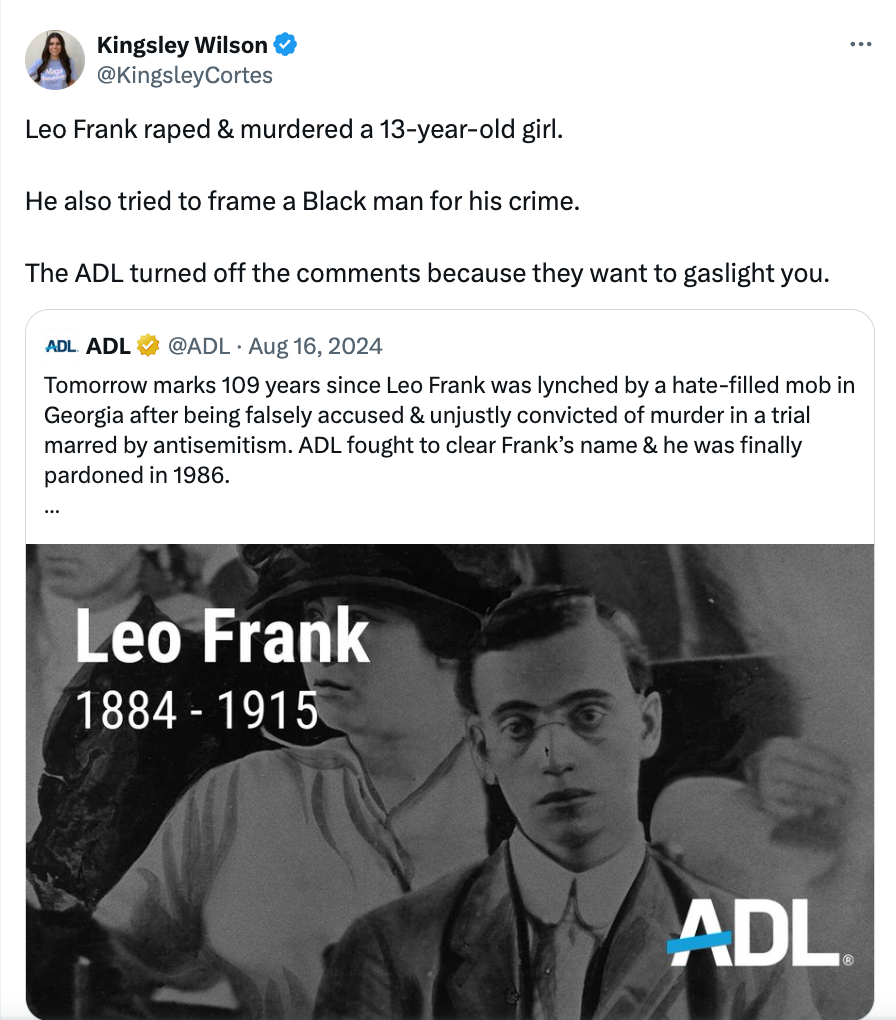
Sanctioned Bigotry shows that neither political party can be exclusively blamed for promoting antisemitism. Rather, members of both major political parties in the US have deployed antisemitic tropes and constructed anti-Jewish policies. For example, conservative commentator Candace Owens has promoted the lie that Leo Frank — a Jewish man lynched in 1915 for purportedly murdering a young girl who worked for him — was properly convicted. Likewise, Kingsley Wilson, the current Department of Defense press secretary, posted on the social media platform “X” about Frank’s supposed guilt. But Republicans are not alone in spreading this falsehood. Bassem Youssef, an Egyptian comedian, also promoted the idea of Frank’s guilt. And this is just one example of the ways in which antisemitism is by no means the exclusive domain of any one political party.
Beyond your book, what would you recommend folks read to get smart about antisemitism in America?
David Gerber’s “Cutting Out Shylock: Elite Anti-Semitism and the Quest for Moral Order in the Mid-Nineteenth Century American Market Place” is one of my absolute favorite academic articles on this subject and in the field of history generally. Another important article that sheds light on this moment is David Schraub’s “White Jews: An Intersectional Approach.” To understand why historians have often minimized antisemitism in historical analyses about American Jews, one must read Tony Michels’s “Is America ‘Different?’ A Critique of American Jewish Exceptionalism.”
William Pencak’s Jews and Gentiles in Early America is excellent. Joseph Bendersky’s The Jewish Threat highlights the pervasiveness of antisemitism in the U.S. Army during the early-to-mid 20th century.
To learn more about white Christian nationalism I recommend reading Eric Ward’s amazing essay, “Skin in the Game: How Antisemitism Animates White Nationalism.” David Austin Walsh’s Taking America Back highlights the many ties between the so-called far right and the mainstream American conservative movement in the 20th century. And I’m looking forward to Andrew Sperling’s The Menace Among Us: The Jewish Fight Against Antisemitism from the Ku Klux Klan to the White Power Movement, which should be out in 2027.
Your book is an archive of sorts. What is one of your favorite archival documents (either from your book or elsewhere)?
It’s hard to designate any of these documents as my favorite because of the subject matter but I certainly think some are exceptionally illuminating and helpful for teaching purposes. One document that gave me pause is a diagram from Telemachus Thomas Timayenis’s The Original Mr. Jacobs (1888), an antisemitic text published in New York City by a Greek immigrant. The diagram is titled “How We May Know Him” and features illustrations of Jews’ supposed body parts along with descriptions. These include “flat feet” and “curved nose and nostrils,” and “thick lips and sharp rats’ teeth.” The diagram is meant to inform readers how to spot a Jew to be able to exclude them from one’s physical space. The document illustrates that Jews underwent racialization in the United States in the 19th century and, contrary to common belief, that racialization process frequently did not identify them as white; the conceptualization of Jews as not white often involved imagining that Jews were chameleon-like and therefore sometimes especially tricky to recognize, a fact that underscored how dangerous they were.
In short, the reason I think this document is particularly useful is because it underscores Jewish racialization, one of the three major intellectual forces that undergirded efforts to deny Jews equal rights.