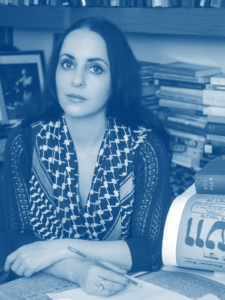
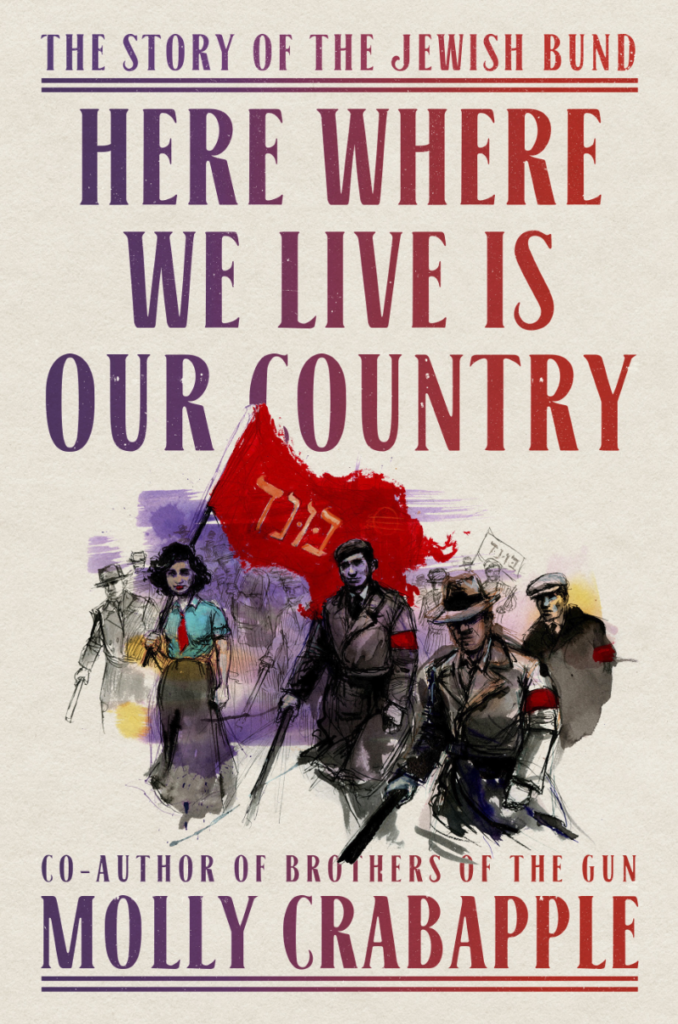
The Jewish Labor Bund was, at its peak, the most popular Jewish political party in Poland: secular, socialist, defiantly anti-Zionist. The Bund built labor unions, sanatoriums, theatrical troupes, and a multilingual press out of what one of its chroniclers calls “little more than love and grit.” Then World War II came, and the Bund was nearly erased: its archives buried under the rubble of the Warsaw Ghetto and never recovered, its Yiddish-language record largely inaccessible, its anti-Zionist politics a liability in postwar Jewish historical memory. Artist, journalist, and author Molly Crabapple spent seven years bringing it back. Here Where We Live Is Our Country (Penguin Random House), the first popular history of the Bund, debuted on the New York Times bestseller list at #4 last month. We spoke with Crabapple about her research, her editorial choices, and what a century-old movement has to say to the American Jewish present.
Tell us about yourself, your career as an artist, journalist, and now an author.
Molly Crabapple: I’m an artist and writer from New York City. I got my start drawing in nightclubs, and after Occupy Wall Street I started working in a form of illustrated journalism, traveling to places of protest and conflict — Ukraine during the Russian invasion, Gaza, the U.S.–Mexico border during the Trump family separation crisis — using my sketchpad the way a photojournalist would use their camera, but writing as well. I’m the author of three books. My last book, Brothers of the Gun: A Memoir of the Syrian War, was co-written with the Syrian journalist Marwan Hisham and longlisted for the National Book Award. I’ve won the Bernhardt Labor Journalism Award for my coverage of the New York City taxi driver hunger strikes, two Emmys for my animations, and my work is in the permanent collection of the Museum of Modern Art. Here Where We Live Is Our Country is my third book.
Could you share a bit about your process of writing the book — from early discoveries to the things you read and time in the archives?
Molly Crabapple: I knew about the Bund because I grew up obsessed with my great-grandfather, Samuel Rothbort. I grew up surrounded by his artwork and by stories about him that my great-aunt Ida and my mother would share. He was such a character, not just the paintings, but photographs of him eating fire, playing a violin he’d made out of Venetian blinds, hanging from a chin-up bar by his ankles in his eighties.
I particularly loved a body of work he called his memory paintings: hundreds and hundreds of watercolors he made from memory about Volkovysk, the town in the Pale of Settlement, now in Belarus, where he grew up. One of those paintings depicted a young woman in a long dress throwing a rock through a window while her boyfriend handed her more rocks. It was titled Itka the Bundist, Breaking Windows. I fixated on the word ‘Bundist’ because this vision of a young woman in the Pale of Settlement throwing a rock through a window was so different from how I, at nineteen, imagined life for a young Jewish woman there would be. I figured the answer to why she was so different was probably in that word.
I began researching the Bund in earnest for an article I wrote for the New York Review of Books called “My Great-Grandfather the Bundist,” published in 2018. It was by far the most viral piece I’ve ever written. After it came out, elderly descendants of Bundists started reaching out to me — people like Victor Gilinsky, whose father Shloyme Gilinsky ran the Medem sanatorium; Irena Klepfisz, the pioneering poet, whose father Michł Klepfisz was a munitions expert in the Warsaw Ghetto; and Mark Erlich, whose grandfather Henryk Erlich was a leader of the Bund in Poland and whose grandmother Sophia Dubnow-Erlich — daughter of the great Jewish historian Simon Dubnow — was an avant-garde poet and a Bundist in her own right. The stories these descendants told me were so precious and so rich that I knew I couldn’t confine my interest to a single article.
The second thing that happened was that YIVO, the Center for Eastern European Jewish History, allowed me to attend their summer Yiddish program twice, for free. That program enabled me to read Bundist firsthand sources. I always say: just as a journalist traveling to another country needs to speak that country’s language, if you want to report on the past, on the dead, you have to speak their language. I don’t think you can write about the Bund without knowing Yiddish.
Once I had my reading chops, I discovered an amazing secular Yiddish bookstore being run out of a large loft in Queens by a man named Hy Wolfe, called CYCO Books. They had the classic Bundist canon, as well as translated works like Samuel Portnoy’s translation of Viktor Alter and Henryk Erlich: Two Heroes and Martyrs of Jewish Socialism and the translated Vladimir Medem memoirs.
I compiled that canon, and went deeper. The Erlich family gave me a privately printed copy of Sophia Dubnow-Erlich’s memoir, Bread and Matzah. She became a touchstone for the book — she was an artist, a poet, and a revolutionary, and as an artist she always had that askance way of looking that was allergic to dogma. Brian Gocial — a descendant of Henoch Rus — gave me a bundle of letters between Szmul Artur Zygielbojm, Maurycy Orzech, and Emanuel Nowogrodzki that he had paid to have translated himself for his own familial research.
Then there were the Bund’s archives at YIVO — the Bund Archive and the Foreign Committee Archive, which are different collections. There were shorter books in YIVO’s stacks that have never been digitized, like a volume on what the events in Palestine could teach the movement, by the Bundist Yoysef Khmurner, written after the 1929 Hebron massacre. I would go to the archive, photograph entire volumes, and translate them myself at home — the same with Viktor Alter’s book of reporting after his 1924 trip to Palestine.
Because the Bund was always a multilingual organization, there were important works in Polish, and I worked with research assistants. Alter and a collaborator co-wrote a book in Polish called Spain in Flames about the Civil War. I also worked through Zygmunt Zaremba’s book on the Nazi siege of Warsaw — Zaremba was a Polish socialist leader who organized the Workers’ Brigades for the Defense of Warsaw during the siege.
I often see historical movements covered exclusively through congress decisions and official statements. But anyone who’s ever been in a movement knows that most people don’t give a shit about the carefully worded decision from the congress. The reason people join movements is very often because of their friends, their lovers, because of what looks cool, because of who has the soup kitchen in their neighborhood.
I also felt it was very important to read the Bund’s enemies. I read Nikolai Sukhanov’s chronicle of the February Revolution, which is quite cynical about Henryk Erlich and Mark Liber. I read work by Bundists who became Communist Party members. I read the Zionist daily Haynt — the most popular Yiddish daily in Warsaw — because they were always fighting with the Bund. And I relied heavily on the Jewish Telegraph Agency, which often has the juiciest material: Bundist delegates throwing chairs at Orthodox delegates’ heads at the Kehilla, street fights between yeshiva boys and socialist newsies. Old newspapers like the Brooklyn Eagle and the early New York Tribune also covered Jewish socialist activity very richly.
The Cullman Center Fellowship at the New York Public Library ultimately saved the book. They gave me a room, brought up any book I requested, and provided enough uninterrupted time to cut a thousand-page draft into something publishable.
How did you manage the balance of writing, synthesis, family history, and lived experience?
Molly Crabapple: At the start I was so overwhelmed by the task. I’d written two books before, both memoirs, and a memoir has a clear beginning and end. So I gave myself freedom — if I was reading Trotsky’s description of some insufferable social-democratic party meeting in 1903 in the back of a Belgian wool cooperative, and it occurred to me that it sounded like my insufferable DSA meetings, I would give myself the freedom to write what it reminded me of.
I had an original draft that was a thousand pages. I just put everything in and then cut. For me, editing has always been the soul of writing. I wrote this sprawling, nonsensical, unsynthesized draft, and then I cut it — and then I’d realize I was missing something, like I was writing about the Polish Socialist Party but hadn’t actually read anything by a Polish socialist. So I’d go back to the archives, and it became this crazy game of cutting and adding and cutting again.
I very strongly wanted this to be a book accessible to people who don’t typically read academic books. I also felt that women’s perspectives within the Bund had been really marginalized in a lot of scholarship. And because I’ve been a lifelong leftist who has been involved in movements, I have a different idea about what the blood and soul of a movement is. I often see historical movements covered exclusively through congress decisions and official statements. But anyone who’s ever been in a movement knows that most people don’t give a shit about the carefully worded decision from the congress. The reason people join movements is very often because of their friends, their lovers, because of what looks cool, because of who has the soup kitchen in their neighborhood. There’s almost always a huge disconnect between the intellectuals’ statements at the conference and how most people actually experience being in a movement. I didn’t want my book to be an endless list of conference decisions.
Why do you think the Bund has been understudied and underexplored?
Molly Crabapple: I think there are a few reasons. The first is that the Bund wrote in Yiddish. If a movement keeps all its archives in a language with a very small number of speakers, it will simply be less studied than a movement that kept its archives in Spanish or French — that’s just the truth.
The second is that a great deal of the Bund’s archives were physically destroyed. The Bund was decimated, like all the rest of Poland’s Jews, in the war. They didn’t contribute to the Ringelblum Archive because of sectarianism — they kept their own archives — and those archives were never found under the rubble of the ghetto. Chunks of material were likely also destroyed as Bundists became members of the Communist Party of the Soviet Union.
But quite frankly, I think it’s because the Bund was an anti-Zionist group, and because of that, it has been marginalized. There’s a remarkable book coming out with Haymarket Books in 2027, edited by Nathan Tankus and Eyshe Beirich, in which Beirich, a Yiddishist, has systematically translated the Bund’s anti-Zionist writings about Palestine, nationalism, and Palestinians — hundreds of pages never previously translated. I think it’s going to change how people understand the Bund’s anti-Zionism.
When I went through the Bund newspaper Naye Folkstsaytung in the archives, I was struck by how much the Bund wrote about Palestinians and how much their critique of Zionism was rooted in universalist ethics and concrete concern for Palestinian people. The idea that the Bund didn’t care about that — that their anti-Zionism was purely sectarian rivalry — simply isn’t true.
Could you talk a bit more about the Bund’s anti-Zionism — what are the hallmarks of it in your book, and how can we understand and learn from it?
Molly Crabapple: The Bund’s anti-Zionism developed alongside Zionism itself. When the Bund was founded in 1897 — the same year as the inaugural Zionist Congress — one of its main early critiques was simply that Zionism was impractical. You’re going to move millions of people to the Levant? Sure you are. They also saw it as philanthropic reputation-laundering by Jewish bosses, and an acquiescence to the bigots who wanted to kick Jews out of Eastern Europe. There’s a line from a Bund local committee around 1903: “We are not strangers here and we are not guests. Though the Russian government considers us as such. This land is soaked through with our blood. And we will stay and fight for that which belongs to us.”
In Bernard Goldstein’s memoir of the Warsaw Ghetto, The Stars Bear Witness, he draws an explicit parallel to Black Americans — writing, while living in the Bronx as an older man, that Black people in America knew they were persecuted, but most of them didn’t desire to move to Liberia; they desired not to be persecuted in America.
As Zionism gained the backing of the British Empire after the Balfour Declaration, the Bund’s critique shifted toward what they saw as collaboration with British imperialism, and the dispossession and impoverishment of Palestinians — the taking of people’s land with British bayonets, the denial of Palestinian rights in collusion with the occupying power. And they wrote about it extensively.
What do you hope American Jews who aren’t familiar with this history would take away from this book?
Molly Crabapple: I think many American Jews have a very flattened idea of what Jewish history is — one single narrative. I’ve honestly been shocked at how many young people have told me they had no idea there was a Jewish history on the left. I’ve also had so many young people tell me they had no idea that any Jews ever fought back against the Nazis or against anyone else. I’ve been told this over and over.
I hope the book gives those readers a sense of who their ancestors were. I hope it conveys the diversity of Jewish history and the Jewish experience — which has always been marked, above all, by intellectual diversity and dispute. The imposition of a singular narrative is ahistorical and, honestly, idiotic.
And we’re facing fascism in America right now. American concentration camp infrastructure for immigrants. A genocide in Gaza. The Bund lived in a time of poly-crisis, and there are so many lessons in how they organized. Leftists today often ask: do we run candidates? Do we do mutual aid? Do we build labor unions? The Bund’s answer was: you do everything. They built everything in interwar Poland — brilliant people in city council, the most popular sports club in the country, labor unions representing tens of thousands of workers, a women’s movement that fought for free childcare, Boy and Girl Scouts, the Medem Sanatorium, theatrical troupes, a multilingual press that introduced impoverished Jewish workers not just to socialist news but to avant-garde literature and theater. When I think about everything they created, I feel the utter heartbreak of how savagely it was murdered. But I think there’s so much we can learn from the world they built — a world built out of little more than love and grit.
We are an archive of American Jewry — is there an American Jewish artifact or document you can point to that was impactful in writing the book?
Molly Crabapple: So many. One major collection I used was the Jewish Labor Committee archives at the Tamiment Library at NYU — I spent days at a time on the microfilm. And Forverts was a central source; I would sometimes read it late at night, searching for things like what the paper had to say about Puerto Ricans. My father is Puerto Rican, and I wanted to see what they thought.
For a more concrete physical object: the Forward Building on East Broadway in New York. What I love about it is the relief portraits on the façade — Ferdinand Lassalle, Karl Marx, Friedrich Engels — and then there’s a bearded man that nobody can definitively identify. Some say it’s Wilhelm Liebknecht, some say it’s August Bebel. To me, he’s the unknown soldier of Jewish leftism — he showed up, he’s clearly carrying a nylon grocery bag full of newspapers, and nobody even knows his name.
For folks who read your book and are inspired, where would you send them next?
Molly Crabapple: If you’re interested in the Warsaw Ghetto, read Emanuel Ringelblum’s writings on it. For the social structures the Bund built, read Jack Jacobs’s Bundist Counterculture in Interwar Poland. But the book I love most, and think is the most accessible, is Bernard Goldstein’s Twenty Years in the Jewish Labor Bund. Bernard was a total gangster — he was the head of the self-defense militia — and he writes about a thrilling world. It’s genuinely funny and genuinely terrifying. I’m told a protesters involved in deed-theft resistance in Brooklyn was reading it aloud on a porch as part of a sit-in to help an elderly woman keep her home. That is everything.
What’s next for you?
Molly Crabapple: Right now I’m in the middle of a twenty-five-stop book tour. Two nights ago I was in New Orleans and over a hundred people came. And yesterday I was with the amazing astrologer Chani Nicholas — she did the Bund’s birth chart. Some of it went over my head, but it was the coolest thing. And I think when I talk about taking this history outside of the contexts where you’d typically expect an interested audience — doing events with people like Chani is part of that. I believe reading history is everyone’s birthright. Once the tour is done, I hope to take a little vacation. And otherwise I’ll be drawing.