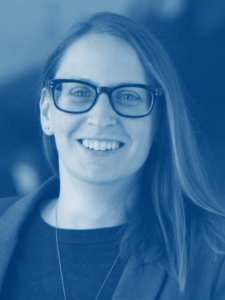
America turned 250 this year — the fanfare, reflections, and bunting have been unmissable. The American Jewish Historical Society came with receipts (30 million) and a lot of great thinking in its effort to tell the story of the Jews who shaped, protected, and sometimes undermined American democracy, from the Revolution to today. The exhibit, podcast, and curriculum, titled All We Have Standing Between Us, is an inspiring example of an archive come to life. We wanted to see what went into this effort and spoke with AJHS executive director Gemma R. Birnbaum to get the back story.
Let’s start with the basics — tell us about your role with AJHS and how you got there.
Gemma R. Birnbaum: I’ve known about this place for as long as I’ve been in the field. I was studying American Jewish history as an undergraduate at NYU right when the Center for Jewish History and these archives had opened nearby, so it felt like this exciting, untapped thing. Then I left for graduate school and ended up in New Orleans, at the National WWII Museum, for almost eleven years. I started in curriculum and website content for distance learning, and in 2017 became the inaugural director of the museum’s Media and Education Center — an umbrella for basically everything public-facing that wasn’t visitation: distance learning, an online master’s with Arizona State, teacher trainings that drew educators from all over the country.
So when this job opened, about a year into the pandemic, I couldn’t believe it. I’d been away from my family in New York for a long time, and here was this collection: 30 million objects, some dating to the 16th century. One of the first things I wanted to fight was the perception that we’re the “New York Jewish Historical Society” — a lot of the scholars we work with have said that themselves. The collection is far more expansive than that. So we’ve focused on digitizing — we’re at about 11 percent, which sounds tiny until you realize it’s three and a half million items — and on podcasts and digital programs. Because an archive, if you’re not careful, can just sit on the other side of a wall. That’s the last thing any of us want.
Let’s go right to America’s 250th and the program you’ve built around it: All We Have Standing Between Us. Tell us about it, and how it meets everything you just described.
The premise is that American Jews, and the country, have never been fully in alignment. There have always been debates, always antagonists, always people who wanted to shape and protect democracy, and sometimes people, Jewish among them, who wanted to undermine it. We’re never all one thing, and American Jews are never all one thing. The debates aren’t even always left and right; sometimes they’re left and further left. Even “community” is a bit of a misnomer, because everyone’s different and everyone evolves.
So it became four things. There’s the onsite exhibition with the Center for Jewish History, up through the end of this year, built by fourteen curators from our scholarly community — two per section, which meant real debates over what to include and how to interpret it, down to how you explain it to a twelve-year-old on a field trip. There’s an online teacher training with the Gilder Lehrman Institute this August, co-taught with Hasia Diner, running from the colonial era through about 2001. There’s the podcast, a companion to the exhibition that stands entirely on its own — every single story in it comes from the AJHS collection, nothing else. And we’re loaning objects to institutions marking the 250th in their own states — the Weitzman in Philadelphia, Newark, as far as California. A lot of those colonial-era documents have either never been displayed or haven’t been out in a very long time. We’ve got podcast listeners in all fifty states, DC, and sixty countries. That matters especially now, when a lot of people aren’t feeling so celebratory.
It’s a charged political moment in general, and for Jews in particular. Were you designing this for now, or for the longer view?
That was the hardest part, and the most stressful. The difficulty is knowing when to stop trying to address the present. We’re historians, not political scientists or sociologists. Some of our collections run right up to the present; we drew on Congresswoman Nita Lowey’s papers, which touch Charlottesville and even a little of the pandemic, though we left the pandemic out. The exhibition goes through Charlottesville — that outward display of hate, almost ten years old now, though it doesn’t feel it. The podcast goes through the Tree of Life shooting and a bit of January 6th. But you can’t really talk about the present, because it changes too quickly — the episodes are recorded months in advance. Every day there’s something that upends my worldview at least a little.
From 30 million pieces of paper there are maybe 10 million people in there — and they’re not all Jewish, but they’re interacting with Jewish people closely enough to end up in an American Jewish archive. Who are they?
Certain figures anchor the sections — Emma Lazarus and others. How do you decide whose story becomes the backbone?
That’s the hardest part, and it’s why I love the podcast — we can just keep making episodes. The exhibit you have to cut. A lot of it came down to the knowledge of the contributors and who they felt comfortable speaking about. I know who I’d choose for the colonial and early national period, but who knows it better than Laura Leibman and Adam Jortner? So we let them choose the figures and the objects. We wanted a mix of the familiar and the unfamiliar — Emma Lazarus, who people know, next to someone like Mordecai Sheftall, who they may never have heard of. Most of us in the field know Judah P. Benjamin even if he’s not our era — the man called the brains of the Confederacy — so he had to be there, with all the hypocrisies his life represents; Shari Rabin and Adam Mendelsohn handle that era and its violence really respectfully.
And we had to cut people. We have the papers of Lewis Levin — one of the first Jews in Congress and a founder of the nativist party that became the Know-Nothings, an utterly loathsome, fascinating figure — and he got cut from the exhibit for lack of room. He’s in the podcast, though; I couldn’t let him go. As Eddy Portnoy has said, not every American Jew is a good American Jew, and those are worth exploring too.
In pulling all of this together, what are some of the ways Jews have shaped America that surprised or excited you?
I’m glad we went beyond the civil rights narrative even as we include it, because it’s essential. We bought beautiful Ben Shahn portraits of James Chaney, Andrew Goodman, and Michael Schwerner for the exhibition, and we tell that story at length in the podcast, in an episode with Britt Tevis and Andrew Sperling, our in-house historian. People know that story, but they may not remember the fear of it — three people missing, the burned-out car on the side of the highway, all for trying to register voters. Scholars like Marc Dollinger and Britt Tevis have given that era the refresh it needed.
For me personally, the surprise was how much I didn’t know. I didn’t know the Know-Nothing party was founded by Lewis Levin. Haym Salomon wasn’t simply a financier — there was the Sons of Liberty, the espionage, the fact that he died completely broke. It’s not that I didn’t know it; I’d never really considered it. Eric Goldstein asked me a good question about how you walk the line between celebrating Jewish contributions and sliding into American Jewish exceptionalism — something we’re always thinking about. But we’re not writing a book with a thesis. It’s a cumulative story of individuals. From 30 million pieces of paper there are maybe 10 million people in there — and they’re not all Jewish, but they’re interacting with Jewish people closely enough to end up in an American Jewish archive. Who are they?
Was there anything in the collection you didn’t know you had, that surfaced through the framework of the 250th?
I had no idea we had a Civil War Union physician’s diary. Shari Rabin mentioned it, so we went to find it, and it details all the grim things that happen to a body during the war — battlefield injuries, trench foot, bullet wounds treated with no penicillin, people dying of infection. I’m both disgusted and fascinated by medical history. Between that diary and other material — Shari and Adam Mendelsohn talk about Rosanna Osterman, a nurse, in their episode — I realized you could do a whole exhibit on the history of American Jewish medicine, starting far earlier than I’d have guessed.
For people who leave fired up and want to go deeper — what should they read?
A few I revisited while working on the 250th. Jonathan Sarna‘s American Judaism is the closest thing to a survey that’s also genuinely well-written — if you want the history of American Jews, start there. Anything Hasia Diner has written. I got very into Steven Ross‘s The Secret War Against Hate, a deep dive into the American Jewish Committee and the fight against domestic hate groups — one of my favorite figures from our own collection, Abraham Shoenfeld, turns up in it. For the Soviet Jewry movement, Shaul Kelner‘s book [A Cold War Exodus], especially if you’re interested in activism, and Gal Beckerman‘s book [When They Come for Us, We’ll Be Gone], which is about sixteen years old now but helped me understand the world I grew up in, in Forest Hills, Queens, where so many Soviet Jewish émigrés were settling in the eighties.
Gemma R. Birnbaum is the executive director of the American Jewish Historical Society, the oldest ethnic archive in the United States. She previously spent nearly eleven years at the National WWII Museum in New Orleans, where she was the inaugural director of its Media and Education Center. All We Have Standing Between Us: 250 Years of Jews and American Democracy is on view at the Center for Jewish History through December 31, 2026; the companion podcast, hosted by Birnbaum, is available wherever you listen.